Building local context into carbon ratings: lessons from East Africa
To dig deeper into this topic, watch our ‘Building viable carbon projects in Africa’ webinar replay, featuring speakers from Standard Bank, GIZ, Mandulis Energy and BURN.
Introduction: setting the context
East Africa has become central to carbon markets. With the highest volume of carbon credits issued relative to GDP, the region now plays an outsized role across a wide range of project types - from clean cooking and nature-based solutions to emerging engineered removals. As activity has grown, so has interest from buyers, investors, and policymakers looking for credible signals of quality and risk.
With the market set to scale, a recurring question emerges: how is local context meaningfully reflected in a carbon rating?
This article focuses on the answer. It looks at how local understanding is built into the BeZero ratings process through deeper data, structured engagement with developers, regional expertise and targeted site-level insight. It also reflects how this approach has evolved as carbon markets mature, and expectations around rigour and transparency increase.
What a carbon rating is - and why local context matters
A BeZero rating is an assessment of the likelihood that a carbon credit delivers one tonne of CO₂e avoided or removed, as claimed. It evaluates whether a project delivers real, additional and durable climate impact, and helps market participants understand risk — where uncertainty exists, how material it may be, and how projects compare on a like-for-like basis.
Importantly, a rating is not a judgement of developer intent, nor is it a certification or approval. It does not replace monitoring, reporting, and verification (MRV). Instead, it provides an independent, evidence-based view on risk, drawing on multiple sources of information and expert interpretation.
Local context matters because many of the risks that shape climate impact are inherently location-specific. Baseline assumptions depend on regional land-use histories and energy access patterns. Permanence and reversal risks vary with climate, ecology and governance. Implementation feasibility is shaped by infrastructure, supply chains, and community dynamics. Policy environments and regulatory stability differ significantly across and even within countries.
These factors cannot be assessed in isolation from where a project operates. At the same time, evidence relevant to these risks is often fragmented or unevenly available, particularly in emerging markets. This is why ratings rely on a layered process that builds understanding progressively, rather than assuming it at the outset.
Desktop research: deeper, more structured, and more local than it sounds
‘Desktop research’ is sometimes interpreted as analysis that is abstract or removed from on-the-ground realities. In practice, it is the analytical foundation that allows local context to be assessed systematically rather than anecdotally.
At BeZero, desktop research begins with structuring and reconciling large volumes of registry and project-level data. Disclosures are often inconsistent in format, scope and quality, requiring careful cleaning before meaningful comparisons can be made. Analysts integrate third-party datasets, academic literature, and geospatial inputs to contextualise project information and test assumptions.
This work enables projects to be assessed consistently across methodologies, vintages and regions. Without a strong analytical foundation, comparisons become arbitrary, risk signals are harder to identify and local context can be misinterpreted rather than clarified.
Crucially, this analytical base is not static. Region-specific datasets are continually expanded, and plot-level and field-derived data are increasingly integrated into models to strengthen how baselines and assumptions are tested. These improvements are particularly important in regions where historical data is limited or variable.
Strong desktop research does not replace local understanding - it enables it. By establishing a rigorous baseline, analysts are better positioned to identify where local nuance is most material, ask more targeted questions and avoid relying on generic assumptions. This foundation sets up the next layer of the process: engagement with project developers.
Developer engagement: turning data into context
Developer engagement plays a central role in the ratings process as a source of analytical insight. Engagement occurs throughout the lifecycle of a rating and is focused on clarifying information gaps, testing assumptions and understanding operational realities that may not be fully captured in documentation alone.
It is important to be clear about the boundaries of this engagement. It is not advocacy, marketing, or an attempt to influence outcomes. Ethical walls are in place to preserve analytical independence, ensuring that engagement informs judgement without compromising it.
What engagement provides is context that data alone cannot. Developers can explain how projects have evolved over time, describe local implementation constraints and highlight operational considerations that affect risk in practice.
This looks different across project types. EcoSafi, a clean cooking project operating in East Africa, provides one example. Engagement with the developer helped clarify local adoption dynamics and usage patterns, strengthening how impact data was interpreted and ensuring analysis reflected real-world conditions.
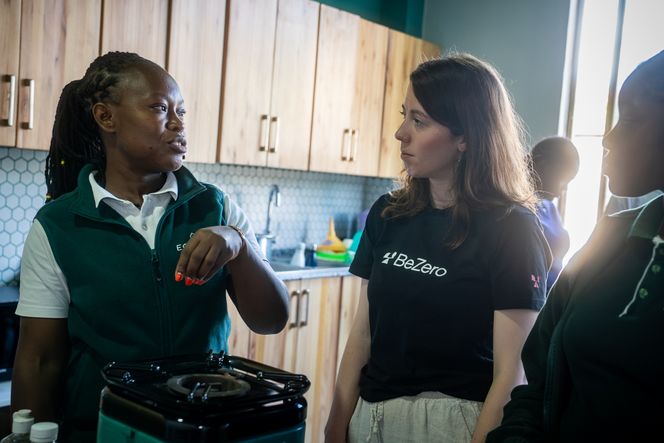
Claire Goldfinch, Senior Developer Engagement Manager at BeZero, at a site visit with a cookstove developer based in Kenya.
By contrast, engagement with Imperative, a nature-based restoration project, focused on complementing soil and ecological data with insight into long-term land management and permanence considerations. Here, developer input helped contextualise biophysical data rather than replace it.
Together, these examples illustrate how engagement functions as an analytical input tailored to project type and regional context.
As Oliver Emanuel, Household Devices Sector Lead, has noted: “Developer conversations do not determine outcomes; however, they help clarify nuance and deepen our understanding. For example, gaining a clearer view of distribution processes and how a project increases accessibility for the target population.”
Local and regional expertise
Local understanding is further strengthened through the integration of regional expertise. This includes collaboration with regional experts, input from teams with on-the-ground access to data, and partnerships with academic and institutional organisations.
Within BeZero, the Geospatial and Earth Observation (GEO) team plays a key role in providing regional context that complements central analytical work. Their insights help surface land-use nuance, biodiversity considerations and regional risk factors that may not be immediately visible through datasets alone.
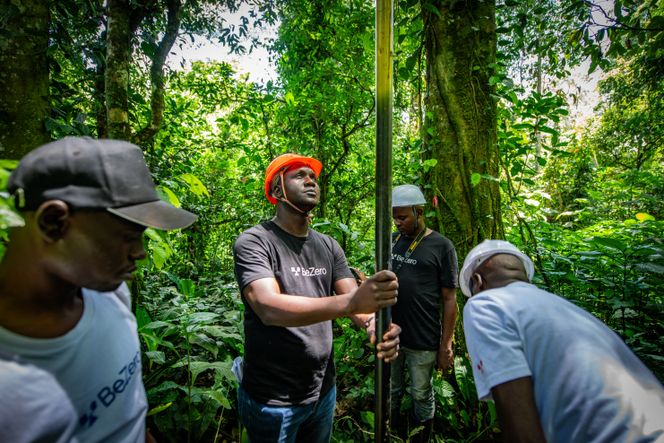
In 2024, BeZero visited Kibale National Park to measure carbon and biodiversity, in collaboration with Uganda Wildlife Authority and local universities.
This matters because it prevents over-generalisation and strengthens confidence in regional assumptions. It also ensures that analysis reflects real variation within regions rather than relying on broad proxies.
As Dr Saheba Bhatnagar, Senior Remote Sensing Scientist at BeZero, puts it: “Local knowledge and geospatial models go hand in hand. Global Earth observation datasets help us identify large-scale patterns, but regional insight guides how we interpret those signals and where more bespoke analysis is required.”
Site visits: validating assumptions, not replacing data
Site visits contextualise analytical assumptions. Recent site visits in East Africa, focused on building broader regional understanding rather than assessing individual projects, provided first-hand insight into implementation realities, community interaction and operational constraints that inform how evidence is interpreted across similar project types.
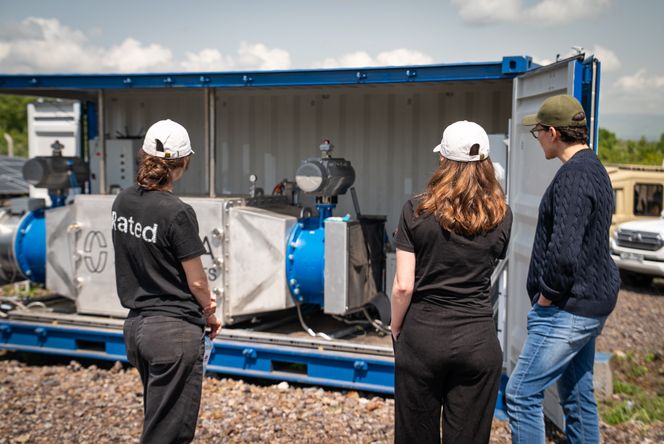
The BeZero team visited a Direct Air Capture pilot facility in Kenya in 2025.
These visits inform how analysts interpret data, which risks are prioritised and how uncertainty is framed. They do not override evidence, but they often sharpen it.
The key point is that site visits enhance - rather than replace - robust analytical processes.
What this means for developers in practice
For developers engaging with the ratings process, this approach translates into a more transparent and collaborative experience.
Developers can expect rigorous analysis, clear explanations of assumptions and risk factors, and opportunities to clarify and contextualise evidence where it is most material. The aim is not just to minimise risk, but to describe it accurately and consistently.
This benefits developers and buyers alike. Clearer signals of project quality support buyer confidence, while reduced uncertainty helps projects stand out in an increasingly competitive market. Importantly, it also reduces the risk of misinterpretation by making analytical judgements explicit.
Conclusion: local understanding is built, not assumed
Local understanding matters, and it always has.
However, proximity is not the only way to build this understanding. Depth of data, meaningful engagement, and thoughtful integration of local insight throughout the ratings process help BeZero’s analysts accurately evaluate a project’s risks.
As carbon markets evolve, this approach will continue to build trust, integrity and confidence in markets that depend on reliable insights.